Features
Runtime Observability Governance, built in.
Default policies, runtime policies, scheduled windows, effective policy inspector, revision history, hierarchy targeting, and pipeline control. All governed at runtime.
Capabilities
Everything you need for runtime governance.
Default policies, runtime policies, scheduled windows, effective policy inspector, revision history, hierarchy targeting, and pipeline control. All governed at runtime.
Default Policies
Define baseline logging behavior for each scope in your hierarchy. The foundation of runtime governance.
Runtime Policies
Override default behavior for a time window. Automatic rollback when the window closes.
Scheduled Windows
Define when runtime policies are active. No manual intervention required.
Effective Policy Inspector
See which policy is active and why across the full hierarchy. Priority, inheritance, and source.
Revision History
Every policy change creates a revision. Review changes and roll back to any previous state.
Automatic Rollback
Runtime policies expire automatically. No configuration drift. No forgotten changes.
Hierarchy Targeting
Apply policies at client, cluster, namespace, or application scope. Each level can override the parent.
Pipeline Targets
Control how log lines are processed: drop, process, or train. Fine-grained behavior control.
Log Squashing
Collapse repetitive log lines into a single signal with occurrence count and time range.
Training Sample Rate
Capture a configurable sample rate for log analysis without overwhelming your storage.
Manual Rollback
Roll back any policy manually before its scheduled expiration. Full control.
Auditability
Complete revision history for every policy change. Who, what, when, and which scope.
Core Capability
Runtime Log Level Control
Govern log levels on any running production service without touching code, triggering a deployment, or restarting the service. The change takes effect at runtime and is fully reversible.
- Supports DEBUG, INFO, WARN, and ERROR levels
- Changes take effect at runtime, not at deploy time
- No code changes, no pull requests, no CI pipelines
- Works with SLF4J, Logback, Log4j, Winston, Pino, and more
- API and dashboard access
checkout-servicepayment-gatewayuser-servicenotification-apiinventory-servicePrecision
Deployment-Aware Targeting
SieveCore understands your deployment topology. Target a specific deployment, canary release, or blue-green environment. Only the selected scope is affected — all other workloads remain unchanged.
- Target by deployment, node, namespace, cluster, or pod
- Canary deployment? Increase logging on the canary only
- Blue-green? Target the new version
- Changes do not propagate to other scopes
- Kubernetes-native targeting
checkout-service
Namespace: production · Cluster: us-east-1
canary-v2.3stable-v2.2Automation
Scheduled Policy Windows
Define when runtime policies are active without manual intervention. Enable verbose logging during business hours, reduce it overnight, or activate it only during peak traffic periods.
- Scheduled activation and deactivation
- No manual intervention required
- Full revision history for every scheduled activation
- Combine with hierarchy targeting for precision
- Automatic rollback when the window closes
Intelligence
Signal Aggregation
Production logs are noisy because the same error repeats thousands of times. SieveCore collapses repetitive log lines into a single operational signal with occurrence count and time range.
- Automatic deduplication of repetitive log lines
- Occurrence count and time range for each signal
- Significantly reduces log volume through automatic deduplication
- Focus on unique signals, not noise
- Complementary to your existing log storage platform
Database timeout
Connection pool exhausted
Governance
Revision History and Auditability
Every policy change creates a revision. Teams can review what changed, who changed it, and roll back to any previous state. Full governance trail for every logging change.
- Complete actor, target, timestamp, and policy recording
- Searchable revision history
- Roll back to any previous revision
- Supports audit workflows for compliance requirements
- Automatic rollback entries recorded
sarah.chen → payment-service
alex.kumar → checkout-service
system → user-service
sarah.chen → checkout-service
Granularity
Multi-Scope Targeting
Apply logging changes at any scope — from entire clusters down to individual pods. Each level of the hierarchy inherits from its parent but can be overridden independently.
- Cluster → Node → Namespace → Deployment → Pod
- Each scope is independent
- Changes do not propagate unless explicitly configured
- Visual hierarchy in the dashboard
- API support for all targeting levels
node-01node-02node-03Safety
Automatic & Manual Rollback
Every policy has an expiration date. When time runs out, SieveCore rolls back to the original log level automatically. No manual cleanup. No forgotten DEBUG logging in production.
- Time-limited policies with automatic expiration
- Manual rollback before scheduled expiration
- Original log level always preserved
- Rollback recorded in audit trail
- No configuration drift
Control
Runtime Policy Engine
Create temporary, scheduled, manual, or emergency policies. Each policy type supports different operational patterns — from routine investigations to emergency incident response.
- Temporary policies with custom durations
- Scheduled recurring policies
- Manual persistent policies
- Emergency policies for immediate activation
- All policies include automatic rollback
checkout-servicePolicy Rules
Comparison
SieveCore vs. manual configuration.
See how Runtime Observability Governance compares to the traditional approach of changing log behavior through code changes and deployments.
| Feature | Manual Configuration | SieveCore★ |
|---|---|---|
| Speed | ||
| Time to change log level | 15–60 minutes | Seconds |
| Requires code change | ||
| Requires redeployment | ||
| Requires restart | ||
| Safety | ||
| Automatic rollback | ||
| Time-limited policies | ||
| Audit trail | ||
| Role-based access | ||
| Targeting | ||
| Per-deployment targeting | ||
| Per-node targeting | ||
| Per-cluster targeting | ||
| Per-pod targeting | ||
| Operations | ||
| Scheduled logging | ||
| Signal aggregation | ||
| Dashboard visibility | ||
Dashboard
Your governance dashboard.
A unified control plane for runtime observability governance. Preview the dashboard views below.
Runtime Filters
checkout-servicepayment-gatewayuser-servicenotification-apiinventory-serviceCluster View
3
Clusters
48
Nodes
11
Policies
us-east-1eu-west-1ap-southeast-1Node View
node-01node-02node-03Audit History
sarah.chen → payment-service
alex.kumar → checkout-service
system → user-service
sarah.chen → checkout-service
Policy Timeline
Signal Aggregation
Database timeout
Connection pool exhausted
The Real Product
The actual dashboard. Not mockups.
Every screenshot below is from the live SieveCore control plane — the same interface your team will use.
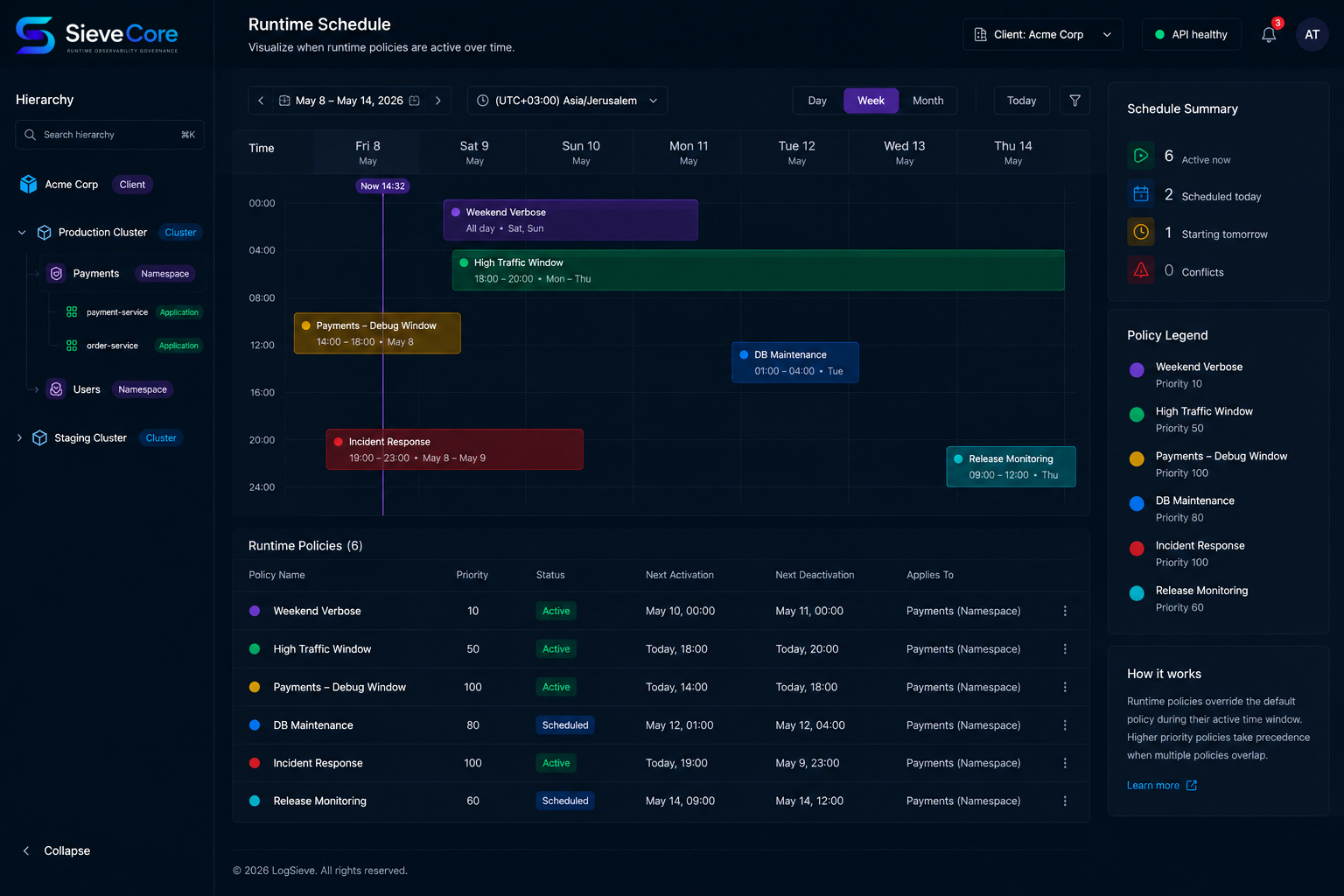
SieveCore policy overview showing active logging policies with status, targets, and log levels
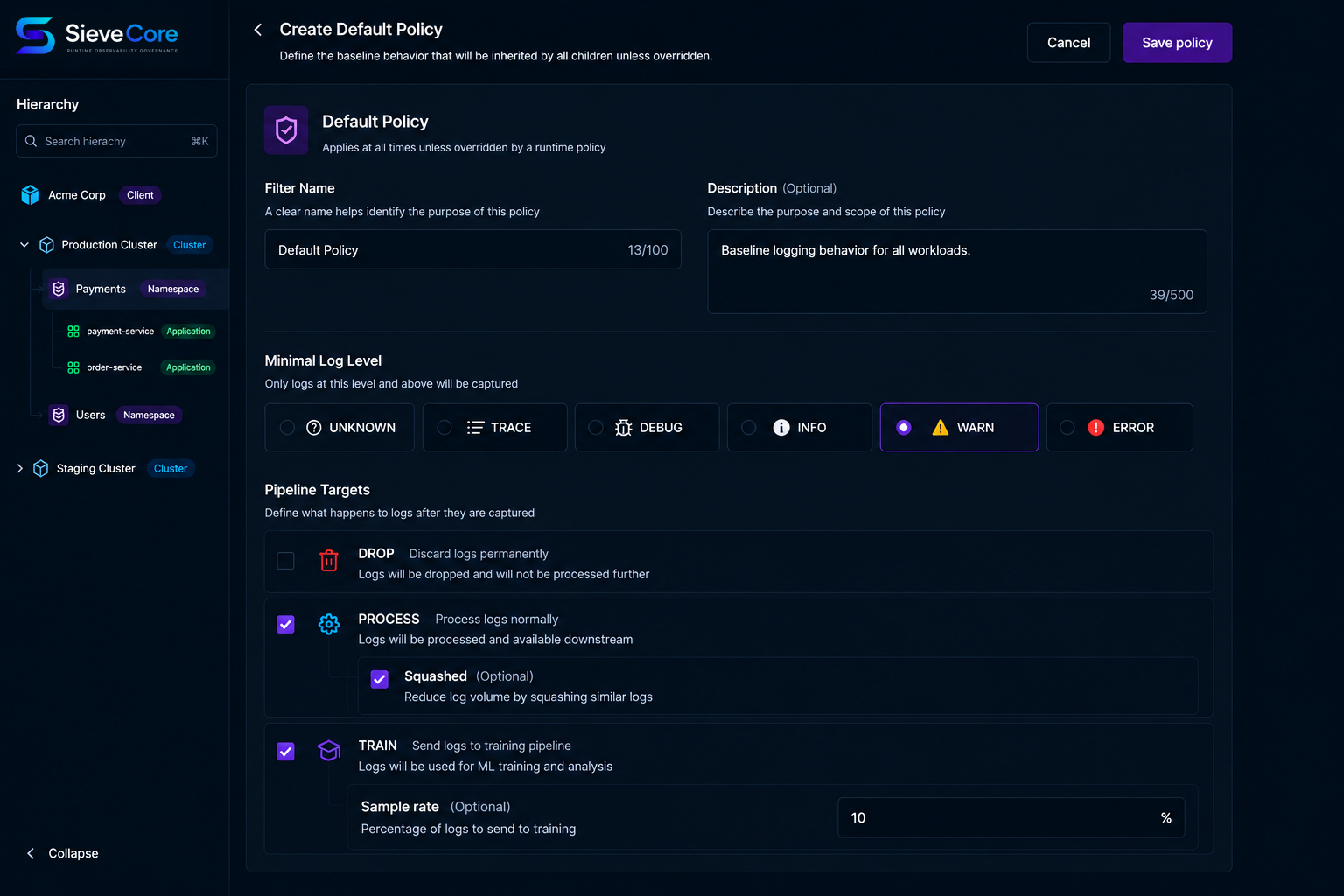
SieveCore default policy creation form with service selection, log level configuration, and target scope
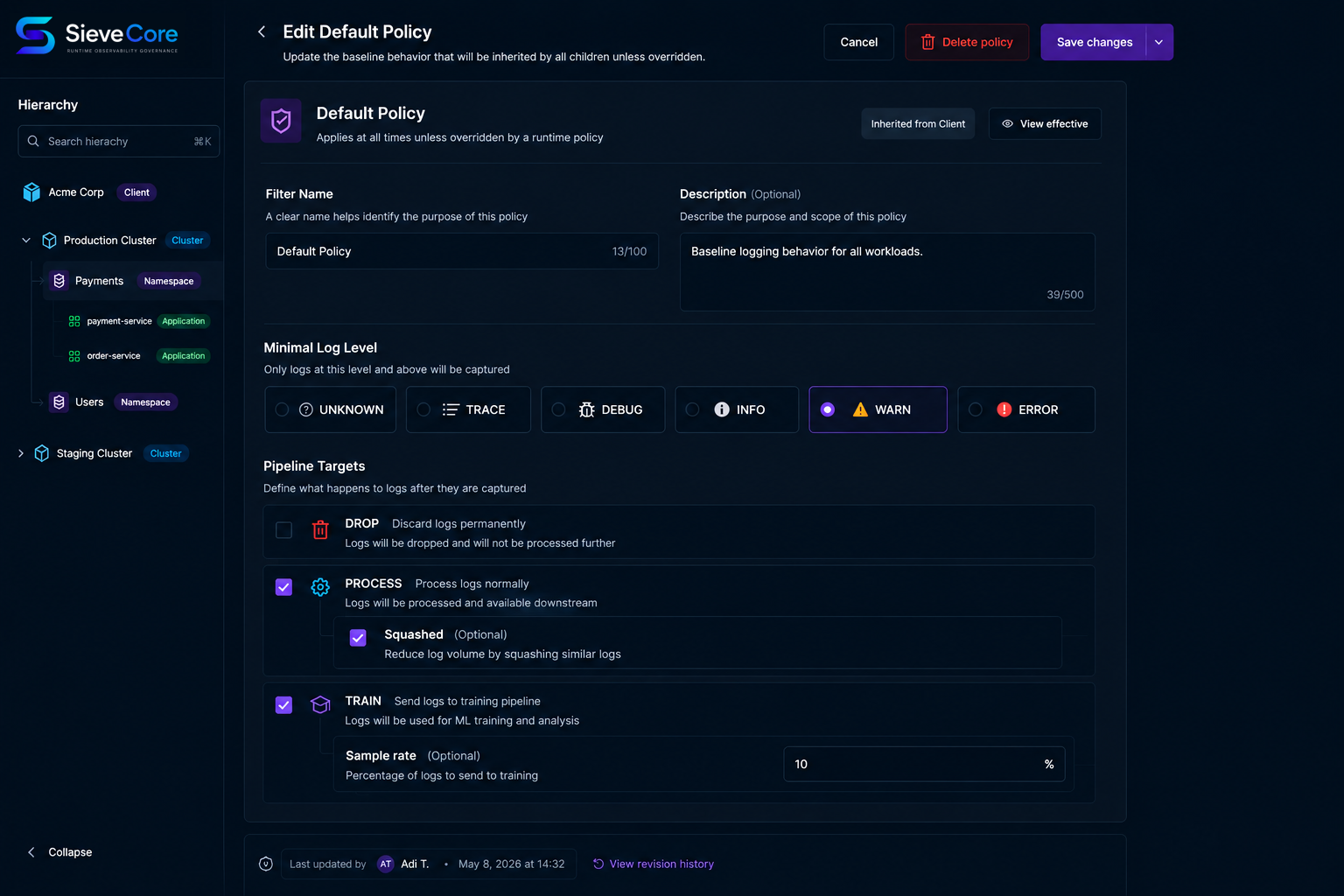
SieveCore default policy editing interface showing existing configuration and modification options
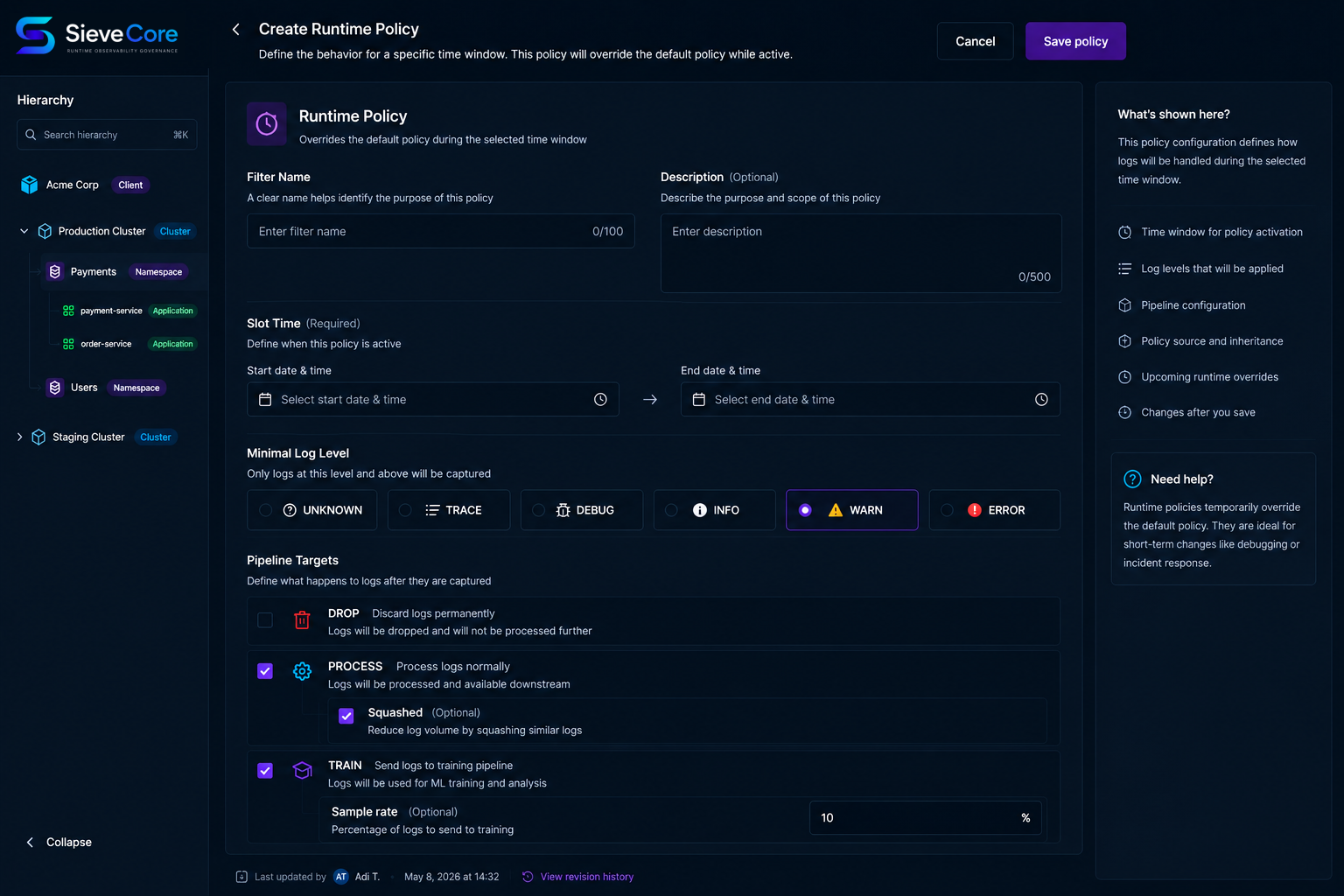
SieveCore runtime policy creation with time-limited logging, deployment targeting, and automatic rollback settings
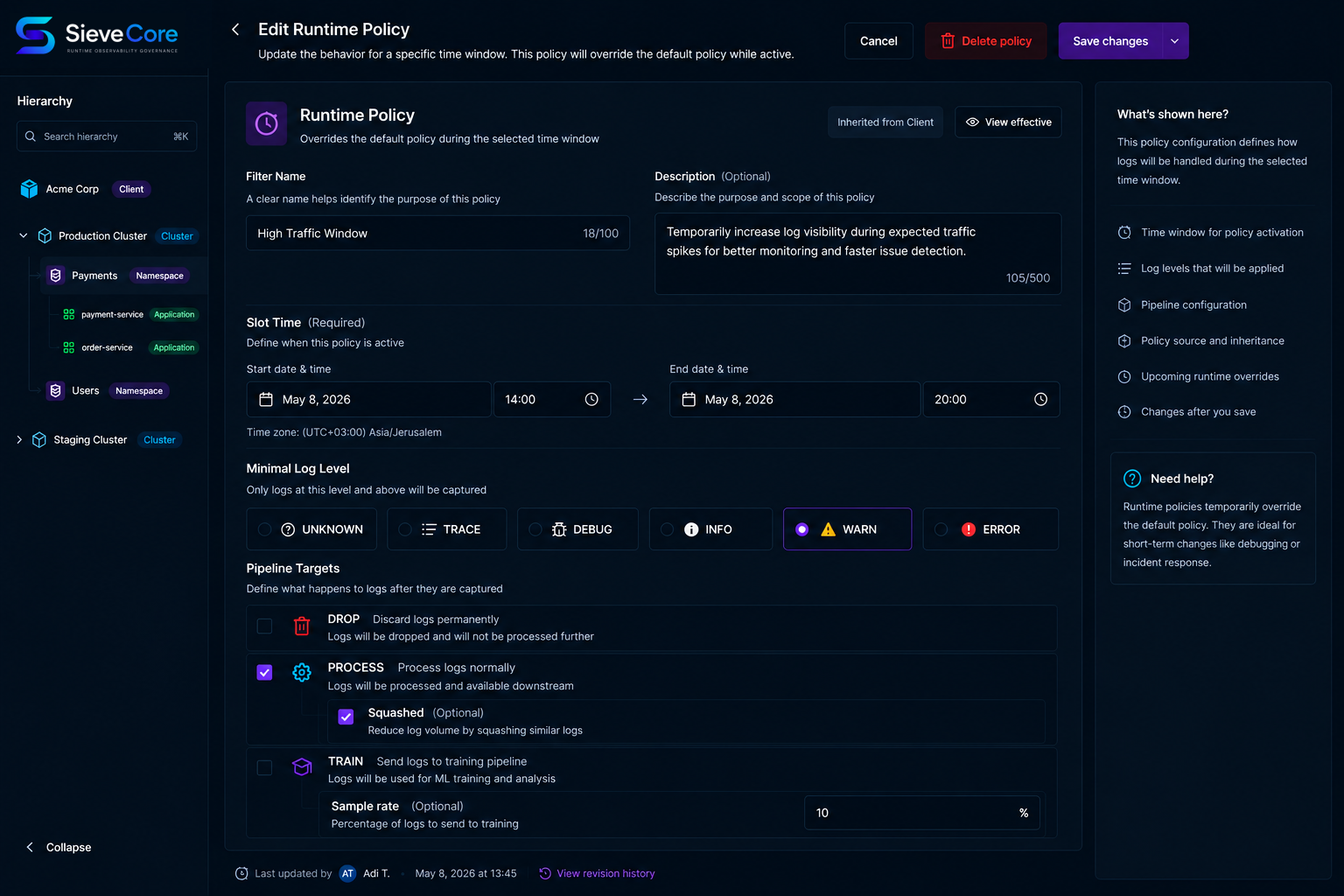
SieveCore runtime policy editing interface with duration, target, and log level adjustments
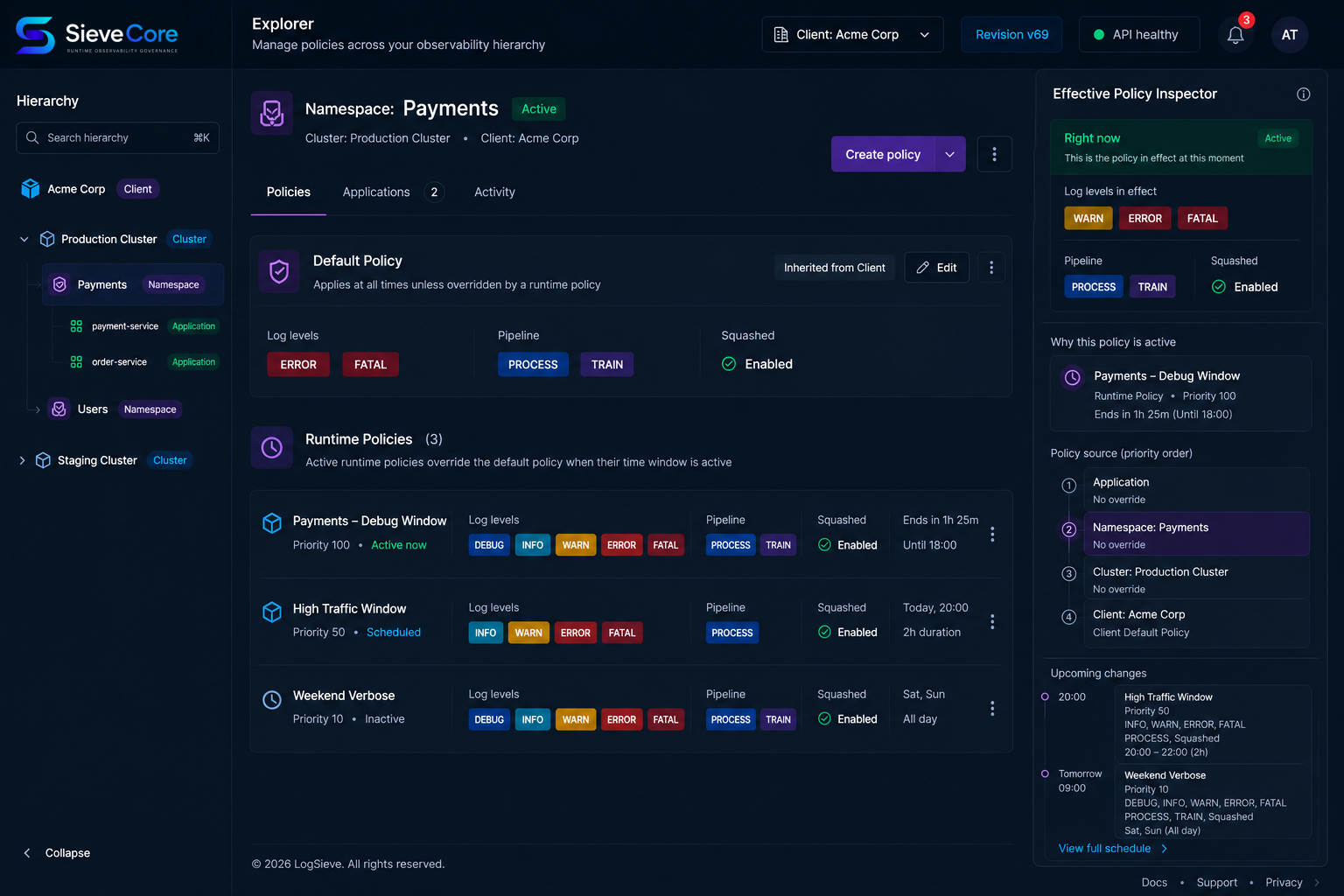
SieveCore Explorer view for browsing and filtering production logs across services and deployments
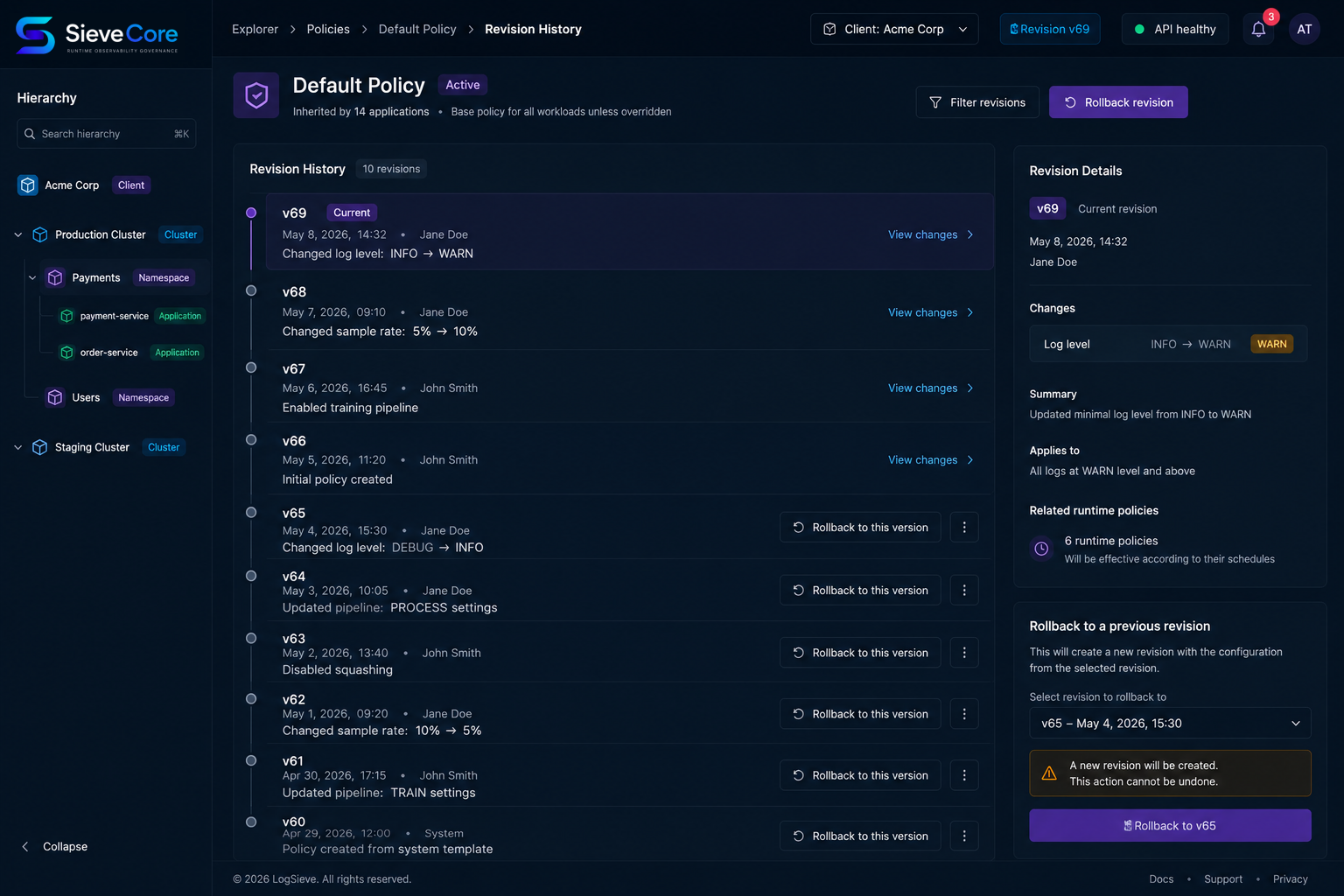
SieveCore revision history showing complete audit trail of policy changes with actor, timestamp, and diff
Questions
Frequently Asked Questions
Ready to govern your production logging?
See how SieveCore gives your engineering team runtime governance over production log behavior.